In between personal, familial and financial failures, Mark Twain took time to see the world and insult the peoples, locales, and histories of the places he visited. It is in this tradition of being annoyingly unsatisfied and too smart for our own good that we present "Not So Innocent Abroad:" a deplorable, ethnocentric, at times hilarious, and always historically unreliable dump on every place we have ever visited.

Showing posts with label Indiana Jones. Show all posts

Thursday, October 14, 2010

Going to love you forever more.........

Waterloo, Belgium

Visiting the battlefield of Waterloo, where on 18 June 1815 Napoleon Bonaparte met defeat at the hands of allied British and Prussian armies under the command of the Duke of Wellington and Field Marshall Gebhard von Blücher respectively, was one of the three greatest experiences in my life. The other two were the day that I became an Uncle and the day I first had sex. If I had to actually rank them, Waterloo would win easily—sorry ladies, I’m sure you’d agree if I asked you to rank my bedroom performance or becoming my niece.

Why? My reason is very idiosyncratic. As a wee lad, I drove into Belgium with my family, yawning at the endless farms of the northeastern French and southwestern Belgian countryside. I was not particularly interested in history, except through my enduring love for the Indiana Jones movies, which were my favorites growing up (and still hold a special part of my soul—such as that shriveled and bitter piece of me continues to gasp and claw for life). But then I saw the pyramid on the horizon and I felt some stirrings of curiosity.

The Dutch King, William I, built a large mound in 1820 on the battlefield where his son, the Prince of Orange, was wounded during the battle (not mortally—pussbag) and placed a large Lion on top of it. When Wellington saw the battlefield afterward, he was extremely upset about the alteration, but he got over it—or maybe he didn’t, I don’t really know. Chances are he forgot all about it when a “doctor” dumped quicksilver in his ear in the mid-1820s to cure a mild infection—inflicting him with intense pain and deafness in that ear for the rest of his life (he lived until 1852!). To say I’m extremely grateful to have been born in a portion of the globe and in a century where such barbarisms are not practiced, but mocked, is like saying I like it when a fat man whips me while telling me I’m a bad boy—a truism.

So I spent a whole morning and early afternoon gazing on a patch of farm fields where on one day in 1815, the fate of Europe hung precariously in the balance. Had it not been for a patchwork force of British regulars, Dutch auxiliaries, a hodgepodge of units from around the British Empire, and a crusty and determined Prussian Prince, Napoleon may very well have returned to rule France leading to god knows how many additional years of ceaseless warfare and baguette rations. I was entranced, much like the first time I saw a woman naked. And, just as in that instance, not knowing how to fully explain it, I wanted to know more.

Thus began a love affair that never ended, though I did eventually abandon a youthful admiration of Bonaparte, I still maintain a healthy respect for Wellington. I am told that since my day, it now costs twelve Euros to get into the visitor center—back then you could still use whatever ridiculous currency one used in Belgium. We went to Brussels later, but I would not recommend that, you’ll just see a bunch of morons protesting whatever International body happens to be meeting in the Belgian capital that day. But definitely see the Battlefield at Waterloo—it’s a truly breathtaking experience.

Based off reminiscences from a trip to Italy, France, Belgium, and Great Britain in 1993.

For more on the Napoleonic period, of which I am something of an expert, see:

Sunday, October 3, 2010

Indiana Dan and the Big Hole in the Middle of the Jordanian Desert that the BBC Calls a Wonder


Petra, The Hashemite Kingdom of Jordan:

Well I found the Canyon of the Crescent Moon but it looks like I was a little late.

 In 600 BCE a community of traders known as the Nabataeans discovered a big canyon created by a massive earthquake and remained there for nearly 800 years without influencing or bothering anybody. During this time their massive cultural achievement was to build a city and to keep it from being destroyed by flash floods and droughts while slowly carving what could be describe as crown molding into the canyon walls. This blissful state of minutia continued through Egyptian, Seleucid and Roman rule until 363 CE, when an earthquake caused the buildings to collapse effecting almost no one and causing very little disruption in the lives of everyone outside of Petra. Over the next 1600 years no one gave a shit, except for a few Bedouins whose prime use for the structures was target practice until Steven Spielberg showed up looking for someplace neat looking to film Indiana Jones and the Last Crusade. This subsequently initiated the only interesting period in Petra’s history and was unfortunately crushed by the interference of the Jordanian government when they realized it was the only place worth visiting in modern day Jordan. A subsequent conspiracy of Indiana Jones fans led to Petra unjustly being named in the second set of Wonders of the Ancient World by British State Television.
This sophisticated trading society used a canyon created by an earthquake to carve out some living space... until the canyon was destroyed by another Earthquake. I wonder if the ancient Nabataean version of FEMA was subsequently blamed.

While the city ruins and canyon itself are a marvel to look at the history is boring once you get past the plumbing that fed water to city and deflected flash floods. The isolation of the city ensured that no great battles ever occurred there and the failure of the Nabataean to resist the influence of other cultures made them the play-dough culture of the ancient world. After their civilization collapsed no one cared until a Swiss Archaeologist named Johann Ludwig Burckhardt showed up in 1812 and even then no one cared because several hundred miles away archaeologist were up to their necks in gold inside the tombs of Egyptian god kings and looming over it all were the great pyramids. For the next 170 years Petra was un-apologetically used as a Bedouin toilet until the gifted location scouts at Paramount found it and used its Nabataean treasury relief as the final resting place of the Holy Grail. The ensuing 20 minutes of film will go down as some of the best ever and includes such memorable quotes as “We named the dog Indiana” and “He chose poorly.” Man I love that movie!
Some geological formations in southern Jordan. Also a Bedouin kid just blowing off school and chilling on a camel.


Anyway the most fun thing about visiting Petra today is actually what a pain in the ass it is to get there and how all of the frustration is tied to much more interesting periods of Middle Eastern History. I for one started my journey in Eilat, Israel, the Jersey Shore of the Red Sea. My harrowing adventure began when a Russian named Jeff picked me up in a decrepit van. It didn’t take long to realize that Jeff was not my tour directors real name and I suddenly started having flash backs to Lifetime Original movies about the white slave trade. Things only seemed to get more troubling at the Yitzhak Rabin Memorial border crossing between Israel and Jordan where I was told to get out of the van, walk through a series of barriers guarded by machine gun wielding 18 year-olds until I got to Jordan. Once in Jordan I was instructed to start yelling for “Osama,” hand Osama my passport and wait on further instructions… yep pretty fucked up.

If crossing the militarized border between the “friendly” nations of Israel and Jordan weren’t unsettling enough, having your tour guide reveal that he fought in the First Chechnyan War against the Russian and then refer to the country you just came from as “the occupied Holy Land” doesn’t improve matters. Fortunately the tour guide explained that our misunderstanding of History was the result of the World Zionist Media Conspiracy. Ironically, were it not for said Zionist media conspiracy no one would have heard of Petra, but for the sake of avoiding a fatwa and knowing that I couldn’t settle differences in Jordan by buying the tour guide a beer, I refrained from commenting.

As an aside the diverse deserts of southern Jordan are a site to behold and were the locations selected for the filming of Lawrence of Arabia. Unfortunately because they are a barren wasteland with almost no water, infrastructure, or economy to speak of these deserts, like much of the Middle East, are basically giant litter boxes. The hostility of the desert was only matched by the hostility of our tour guide and the Hashemite government, which demanded 55 American dollars just to get into the country. And the harrowing journey only became more extreme upon arrival when it was revealed that the price to enter Petra is in fact 90 American dollars. Furthermore just to get to Petra a person has to walk over a kilometer in 115 degree Fahrenheit heat to reach the canyon, all the while the Chechnyan guide struggles to make a series of water troughs sound interesting.
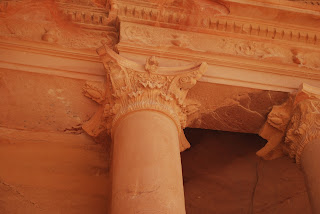
Stupendous crown molding. You would have to go to a classy Home Depot to get something like this.

It is difficult to say whether the hassle, cost, and risk are all worth it in the end to see the world’s most famous example of crown molding. I happen to really like camels and it is a constant source of entertainment to watch Bedouin kids come screaming by driving the heat stricken and overweight in horse carts from the site to the entrance. I am serious about this, have you ever seen a horse try to carry a three hundred pound women in shorts, a Hawaiian shirt and sun hat. That folks is a real wonder.

Verdict: A trip to Petra (transportation, food, taxes, and park fees) will run you 250 dollars a person and could possibly kill you, making it a similar experience to getting a hooker in Vegas. Difficult to know which is more satisfying 

Dan Roberts,
August 2010