In between personal, familial and financial failures, Mark Twain took time to see the world and insult the peoples, locales, and histories of the places he visited. It is in this tradition of being annoyingly unsatisfied and too smart for our own good that we present "Not So Innocent Abroad:" a deplorable, ethnocentric, at times hilarious, and always historically unreliable dump on every place we have ever visited.

Showing posts with label T.E. Lawrence. Show all posts

Sunday, October 3, 2010

Indiana Dan and the Big Hole in the Middle of the Jordanian Desert that the BBC Calls a Wonder


Petra, The Hashemite Kingdom of Jordan:

Well I found the Canyon of the Crescent Moon but it looks like I was a little late.

 In 600 BCE a community of traders known as the Nabataeans discovered a big canyon created by a massive earthquake and remained there for nearly 800 years without influencing or bothering anybody. During this time their massive cultural achievement was to build a city and to keep it from being destroyed by flash floods and droughts while slowly carving what could be describe as crown molding into the canyon walls. This blissful state of minutia continued through Egyptian, Seleucid and Roman rule until 363 CE, when an earthquake caused the buildings to collapse effecting almost no one and causing very little disruption in the lives of everyone outside of Petra. Over the next 1600 years no one gave a shit, except for a few Bedouins whose prime use for the structures was target practice until Steven Spielberg showed up looking for someplace neat looking to film Indiana Jones and the Last Crusade. This subsequently initiated the only interesting period in Petra’s history and was unfortunately crushed by the interference of the Jordanian government when they realized it was the only place worth visiting in modern day Jordan. A subsequent conspiracy of Indiana Jones fans led to Petra unjustly being named in the second set of Wonders of the Ancient World by British State Television.
This sophisticated trading society used a canyon created by an earthquake to carve out some living space... until the canyon was destroyed by another Earthquake. I wonder if the ancient Nabataean version of FEMA was subsequently blamed.

While the city ruins and canyon itself are a marvel to look at the history is boring once you get past the plumbing that fed water to city and deflected flash floods. The isolation of the city ensured that no great battles ever occurred there and the failure of the Nabataean to resist the influence of other cultures made them the play-dough culture of the ancient world. After their civilization collapsed no one cared until a Swiss Archaeologist named Johann Ludwig Burckhardt showed up in 1812 and even then no one cared because several hundred miles away archaeologist were up to their necks in gold inside the tombs of Egyptian god kings and looming over it all were the great pyramids. For the next 170 years Petra was un-apologetically used as a Bedouin toilet until the gifted location scouts at Paramount found it and used its Nabataean treasury relief as the final resting place of the Holy Grail. The ensuing 20 minutes of film will go down as some of the best ever and includes such memorable quotes as “We named the dog Indiana” and “He chose poorly.” Man I love that movie!
Some geological formations in southern Jordan. Also a Bedouin kid just blowing off school and chilling on a camel.


Anyway the most fun thing about visiting Petra today is actually what a pain in the ass it is to get there and how all of the frustration is tied to much more interesting periods of Middle Eastern History. I for one started my journey in Eilat, Israel, the Jersey Shore of the Red Sea. My harrowing adventure began when a Russian named Jeff picked me up in a decrepit van. It didn’t take long to realize that Jeff was not my tour directors real name and I suddenly started having flash backs to Lifetime Original movies about the white slave trade. Things only seemed to get more troubling at the Yitzhak Rabin Memorial border crossing between Israel and Jordan where I was told to get out of the van, walk through a series of barriers guarded by machine gun wielding 18 year-olds until I got to Jordan. Once in Jordan I was instructed to start yelling for “Osama,” hand Osama my passport and wait on further instructions… yep pretty fucked up.

If crossing the militarized border between the “friendly” nations of Israel and Jordan weren’t unsettling enough, having your tour guide reveal that he fought in the First Chechnyan War against the Russian and then refer to the country you just came from as “the occupied Holy Land” doesn’t improve matters. Fortunately the tour guide explained that our misunderstanding of History was the result of the World Zionist Media Conspiracy. Ironically, were it not for said Zionist media conspiracy no one would have heard of Petra, but for the sake of avoiding a fatwa and knowing that I couldn’t settle differences in Jordan by buying the tour guide a beer, I refrained from commenting.

As an aside the diverse deserts of southern Jordan are a site to behold and were the locations selected for the filming of Lawrence of Arabia. Unfortunately because they are a barren wasteland with almost no water, infrastructure, or economy to speak of these deserts, like much of the Middle East, are basically giant litter boxes. The hostility of the desert was only matched by the hostility of our tour guide and the Hashemite government, which demanded 55 American dollars just to get into the country. And the harrowing journey only became more extreme upon arrival when it was revealed that the price to enter Petra is in fact 90 American dollars. Furthermore just to get to Petra a person has to walk over a kilometer in 115 degree Fahrenheit heat to reach the canyon, all the while the Chechnyan guide struggles to make a series of water troughs sound interesting.
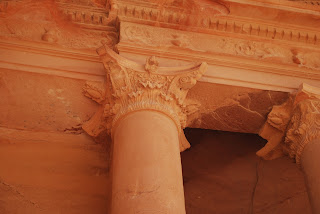
Stupendous crown molding. You would have to go to a classy Home Depot to get something like this.

It is difficult to say whether the hassle, cost, and risk are all worth it in the end to see the world’s most famous example of crown molding. I happen to really like camels and it is a constant source of entertainment to watch Bedouin kids come screaming by driving the heat stricken and overweight in horse carts from the site to the entrance. I am serious about this, have you ever seen a horse try to carry a three hundred pound women in shorts, a Hawaiian shirt and sun hat. That folks is a real wonder.

Verdict: A trip to Petra (transportation, food, taxes, and park fees) will run you 250 dollars a person and could possibly kill you, making it a similar experience to getting a hooker in Vegas. Difficult to know which is more satisfying 

Dan Roberts,
August 2010

Thursday, September 30, 2010

Rescuing Artifacts in Foreign Lands or How I Learned to Stop Caring and Stole from the House of Saud

Desert outside Jeddah, Saudi Arabia

I lived in a foreign country for three and a half years when I was 9 through 12 years old. It was a fantastic experience I would never trade for anything and it allowed my family and I to travel extensively in Europe and some of the adjoining countries of the Middle East. It also allowed me to pilfer artifacts from my host country. In our post-modern, post-colonial world of BS, this activity is passĂ© to put it mildly. Though I never bow in the direction of such non-concerns, I will offer one word in my defense before I explain some aspects of living in Saudi Arabia as an American ex-Patriot boy: the Saudis do not preserve their own historical sites and when asked if you can take their artifacts, they merely shrug their shoulders and assent—it is, without doubt, the best part of the country.

The country of Saudi Arabia only dates back to 1932, when the Kingdom of the House of Saud was proclaimed and recognized by other world governments (though official “Independence” probably dates back to the 1920s, the country was neither unified nor recognized politically until ’32). Before that date, the Kingdom was, like much of the rest of the region, in the state of a quasi-protectorate of Great Britain, dating back to its liberation from the Ottoman Empire during World War I. When I arrived two days before my ninth birthday in 1993, I knew none of this. My experiences in Saudi Arabia and the world around it changed who I was from an annoying, oblivious, pain-in-the-ass child to an annoying pretentious know-it-all teenager. This story is a component part of that larger development.

The Red Sea entrepĂ´t of Jeddah is the main reception point of pilgrims on the Hajj. A city of over 3 million inhabitants (in a country of roughly 27 million) Jeddah is ancient—dating back to the sixth century BC. The city today extends broadly in every direction leading from the original settlement—lovingly referred to as “Old Jeddah.” Old Jeddah’s highlights include men doing their business on the sidewalks into specially designated “holes” that lead to some form of sewer system along with the omnipresent smell of the former activities, and the occasional beating of some offender of the faith—usually a woman—by the officers of the Saudi Ministry of Vice and Virtue, called Mutawwas. It’s a lovely place.

The rest of the city is “modern,” in the sense that it is covered by Western fast-food restaurants like Burger King and KFC, as well as traffic roundabouts displaying some sort of avant-garde sculpture including closed fists, 18th-19th century sailing vessels, and just about everything else you can think of in sculpture form. Western ex-Patriots do not generally live in and amongst the city’s population. Instead, they live in compound enclaves with all of the other “Westerners” including, it must be added, Indians, Pakistanis, Lebanese, and a host of other nationals not generally called “Western,” but who are also too afraid to live among the Saudis and have more in common with the Americans, Britishers, French, Germans, and other Europeans. Ah, colonialism!

Everyone on these compounds employs a maid. Why? Just like in 19th century America, hiring domestic help is really cheap in Saudi Arabia and there are numerous immigrants from places like Ethiopia and the Philippines that the Saudis allow to enter the country for this express purpose. We had several such domestics when I lived in Saudi Arabia, they were always afraid of our dog, Churchill, a pug we brought with us from Chicago. That dog died one of the most traveled canines in history.

Anyway, I attended a British Academy while I stayed in Saudi Arabia called Continental, where when we weren’t learning to keep women locked in our hotel suites with offers of champagne, we were always plotting nifty outdoor excursions into the Saudi wilderness. On one such trip, particularly emblazoned on my memory, we visited the old Turkish railroads. The Ottomans built a rather extensive railroad from Acaba (in the modern day Kingdom of Jordan) to Jeddah and points beyond to move soldiers and supplies around more easily and to bypass Bedouin tribesmen. During the First World War, the British sent in one of their most famous interlopers, T. E. Lawrence, to stir up the locals with false promises of independence from the Turks. He succeeded brilliantly, turning local Bedouins into a rag-tag “Legion” that he used to disrupt Turkish movements and destroy their rail system, eventually capturing Acaba and then moved on to Damascus, all thrillingly depicted in the David Lean film Lawrence of Arabia. On a side note, that film was watched annually in a debauched bacchanalian festival at the British consulate in Jeddah—as a child, I was not invited. Damn limey bastards!

The Saudis, being a country of Bedouins and fishermen, had no idea what to do with these railroads and, for some reason, no use for shuffling Turkish soldiers around. They never repaired them or stripped them for scrap iron; they just sit there, baking in the desert sun, year after year after year—much like the rest of the country. When I visited them, you could still see the remnants of Lawrence’s campaigns as sections of the track were obliterated and bits and pieces were scattered in all directions. When I and some of my cosmopolitan collection of young friends began picking up these pieces, we became aware that perhaps we weren’t supposed to. Someone asked the local Saudi guide if we could take them home as souvenirs and he indicated it didn’t matter to him and the hunt was on! All of us took several pieces and went home extremely satisfied. And to this day some of my greatest souvenir show pieces from my world travels are rusted over shards of the rail roads Lawrence destroyed in a campaign to take down a lame worthless empire built around putting your feet up!

Old rusted Turkish Railroad, stolen and transported over 8,000 miles across the globe to Las Vegas.


Look at that high quality Turkish craftsmanship!


If you’d ever like to visit Saudi Arabia and the railroads, you have to have a sponsor inside the country and some seemingly “legitimate” reason for doing so, if you’re not a Muslim pilgrim. Since there never could be such a reason to visit such a place, you cannot do so. Hundreds of seemingly worthwhile gentlemen, seeking to stone their wives to death, are turned away every year in the effort to rid themselves of horrendous nags—the Saudis are very discriminating.

Even if you could get in, I’d prefer you didn’t, each additional person who absconds with pieces of the railroads makes my story less unique—get your own damn stories!

Based off reminiscenses circa 1995.

For some great takes on the Mideast, see these enlightening books and David Lean's epic masterpiece: